- enquiries@pdaltd.com
- Main Office: 01925 759380

Project Brief:
PDA Ltd was commissioned by a dairy supplier in North England to undertake a detailed noise source investigation following reports of noise complaints from nearby residents. The site operates 24 hours a day, seven days a week, and concerns had been raised about a persistent “tinny” noise occurring during nighttime hours, reportedly causing sleep disturbance.
To identify the source and assess its impact, PDA conducted a comprehensive noise survey. This included long-term unattended ambient noise monitoring near the site boundary, attended short-term measurements of individual plant items, and monitoring at representative residential receptor locations.
Complaints were understood to have coincided with the installation of new plant equipment. To explore this, predicted noise levels from the recently installed plant were compared with baseline levels associated with normal site operations. Noise modelling and analysis were carried out using SoundPLAN software to assess the potential impact of these changes.
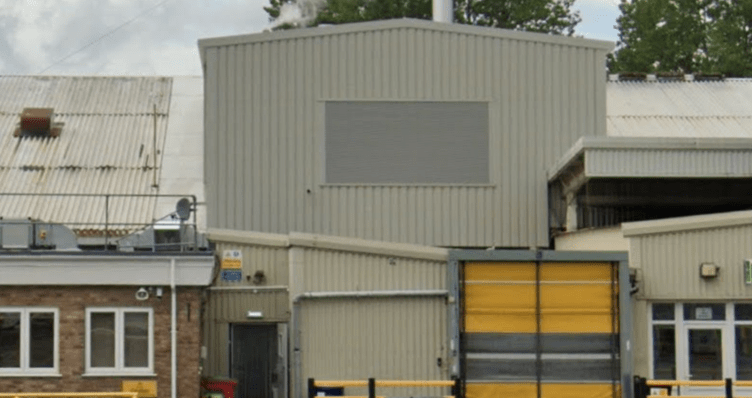
Figure 1: SPX Unit Louvre
Acoustic Challenges:
One of the primary challenges in this project was the complexity of accurately identifying and quantifying the contribution of multiple individual noise sources across a large, operational dairy facility. The site included a diverse range of plant and equipment, such as refrigeration units, vacuum pumps, air compressors, and ventilation systems—many of which operated intermittently or with variable load profiles depending on the time of day and production activities.
Identifying and isolating there overlapping noise sources was particularly difficult due to several factors:
Proximity and Layout of Equipment: Many noise sources were located close to each other, creating a cumulative effect that masked the contribution of individual units.
Variability in Operation: Some equipment operated on cycles or in response to production demands, meaning not all sources were active at any one time, complicating direct measurement.
Environmental Influences: Hard surfaces such as concrete yards, building façades, and enclosed plant areas created reflections and reverberation effects that influenced how sound propagated and was perceived at various positions around the site. These acoustic interactions made it more difficult to audibly and visually separate individual sources, especially when conducting measurements near multiple active units.
Access Limitations: Certain equipment was either enclosed, located at height, or not easily accessible during operation, limiting the options for close-range measurement or isolation.
To address this, a combination of long-term monitoring, attended measurements, and frequency spectrum analysis was used, along with strategic positioning of measurement equipment. This approach allowed us to isolate key contributors, estimate their relative impact, and model the cumulative sound propagation to nearby sensitive receivers.
Assessment:
With all on-site measurements carried out, PDA compared the previous operational noise levels against the current operation including the newly installed plant items to determine the overall noise impact.
Comparison was made between the pre-existing noise levels from the site and those following installation of the new plant. A reasonably significant increase of between 9 – 13 dB was predicted at the nearest noise sensitive receivers(NSR’s).
Noise levels of up to 48 dB LAeq were predicted at the facade of the NSR’s therefore, assuming partially open windows it was determined that the internal night time noise criteria of BS8233 (30dBA LAeq, 8 hours) is likely to be exceeded. On this basis it was considered that noise emissions from the site have the potential to give rise to noise nuisance if left untreated.
Comparison of noise levels are shown in Table 1 below:
Table 1: SoundPLAN Results – Sound levels at NNSRs Due to Newly Added Plant Items.
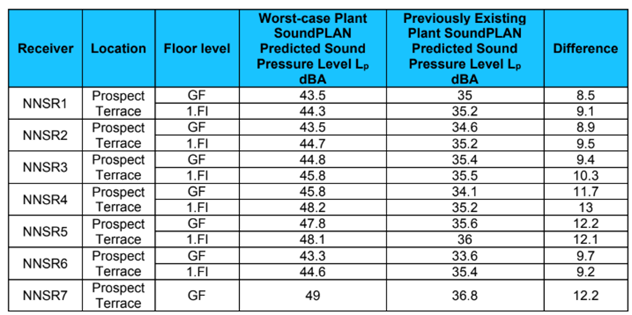
The cause of the significant increase in sound levels due to plant emission at the noise sensitive receivers was shown to be from newly added plant i.e. the SPX Unit and Diesel Refrigeration Trailers, as such mitigation was recommended.
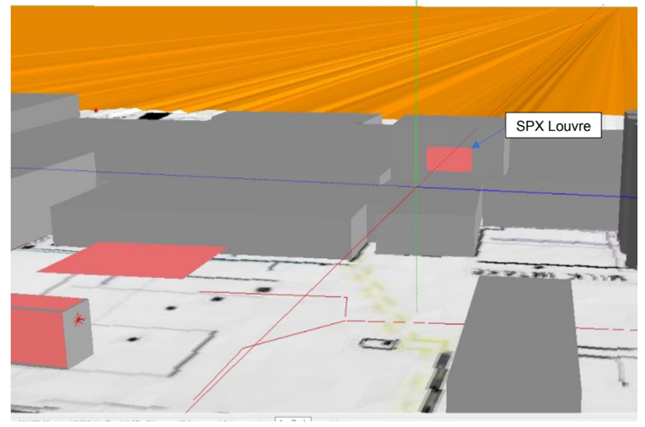
Figure 2: SoundPLAN noise mapping model showing isometric view of SPX Lourve associated with Production Area
Mitigation:
To achieve reduced noise emissions to similar levels to the previously existing “normal operation” at noise sensitive receivers, the following mitigation measures were recommended:
Outcome:
Following a detailed investigation and collaborative assessment process, PDA Ltd proposed a series of targeted noise mitigation measures. Acoustic modelling demonstrated that, with these measures in place, the overall noise level associated with the site would result in only a 3 dB increase compared to the previous operational baseline at the worst-case receiver. This level of change was considered to be negligible and is unlikely to result in adverse effects or trigger further complaints from nearby residents.
PDA’s involvement was instrumental throughout the project, not only in identifying and quantifying individual noise sources but also in working closely with the company’s design and engineering teams to develop practical, cost-effective solutions. This collaboration ensured that acoustic considerations were integrated into the proposed design changes without compromising operational requirements.
By combining detailed measurement, predictive modelling, and stakeholder engagement, PDA supported a proactive resolution to the noise complaints and helped safeguard the company’s ongoing operations while maintaining good community relations.
Read more about Noise Impact Assessment
© 2025 PDA Ltd. All rights reserved.
Website Design by M3SM